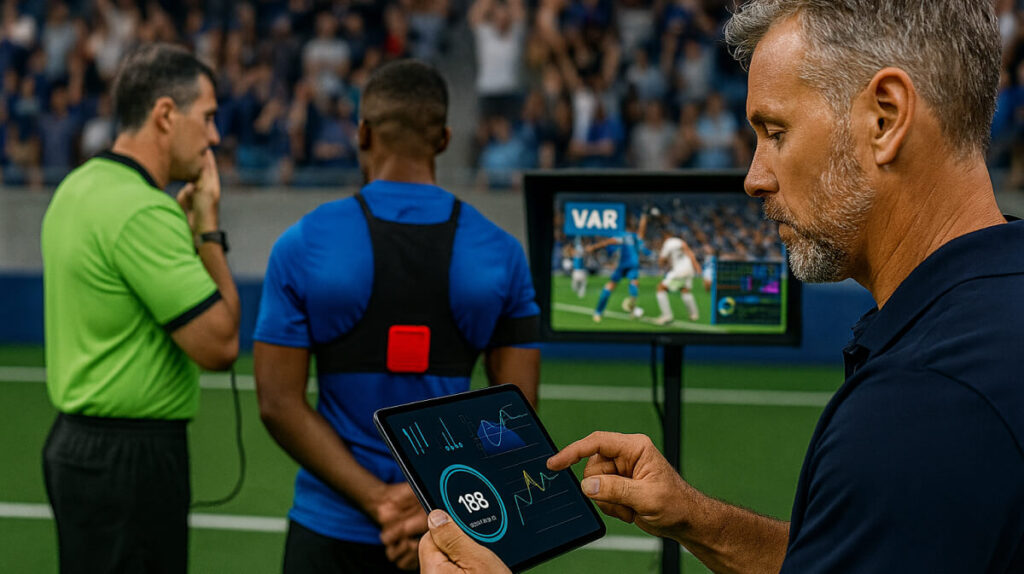
A decade ago, coaches relied on stopwatches and gut feeling to judge how their players were performing. Today, that same job is done by sensors, cameras, and algorithms that track almost everything happening on the field in real time. Sports technology is the reason a broadcast can show you a player’s exact sprint speed seconds after they cross the line, or why a referee’s decision can be reversed by a video review like VAR, before the crowd even finishes booing.
In this article, we’ll break down what sports technology actually means, the main categories it covers, including analytics, wearables, artificial intelligence, virtual and augmented reality, and smart stadiums, and how each one is changing performance, officiating, and the fan experience. By the end, you’ll understand not just what sports technology is, but why it matters to how sports are played, judged, and watched today.
What Is Sports Technology?
Sports technology refers to the tools, devices, and systems used to improve how athletes train, how games are officiated, and how fans experience sports. In simple terms, it is any piece of technology, whether hardware or software, built specifically to support performance, decision-making, or entertainment within sports.
The term covers a wide range of categories, and most of what falls under sports technology today can be grouped into five broad areas:
- Analytics and data, used to measure and interpret performance
- Wearable devices, worn by athletes to track physical output in real time
- Artificial intelligence, used to predict outcomes and reduce injury risk
- Virtual and augmented reality, used for training and immersive fan experiences
- Smart venue infrastructure, used to connect stadiums, broadcasts, and live data
Each of these categories we listed above plays a different role. Analytics tells teams what happened and why. Wearables capture what is happening to an athlete’s body in the moment. AI helps predict what might happen next. VR and AR change how people experience a game, whether they are training for it or watching it from home. Smart stadiums tie all of this together, turning a physical venue into a connected environment that feeds data to coaches, broadcasters, and fans at the same time. See the smart stadium as a central hub where all the data is collected and transmitted to users.
None of these technologies work in isolation anymore. A single professional match can involve wearable sensors, AI-powered video analysis, and a smart stadium system all running at once, feeding information to different people for different reasons. That overlap is part of what makes modern sports technology so powerful, and it’s exactly what we’ll unpack in the next section.
How Is Technology Used in Sports?
Technology is used in sports to measure performance, prevent injuries, assist officiating, and create better experiences for fans. It touches almost every part of the game, from what happens on the training ground to what a viewer sees on their screen at home. Today, fans and sports analysts receive live match statistics and player performance metrics while the game is actively in progress and turn them to valuable insights. All of this wouldn’t have been possible without sports technology. Below, we highlight how these technologies are used in sports today.
Sports Analytics and Data
Sports analytics is simply the act of collecting and interpreting data to understand performance. Many sports teams you can think of today use player tracking systems that record movement, speed, distance covered, and positioning during every match. This data helps coaches see patterns that are easy to miss with the naked eye, such as a player’s tendency to drift out of position in the final ten minutes of a game.
Beyond individual performance, analytics also shapes team strategy. Clubs study opponents’ passing patterns, shot locations, and defensive shape before a match, then adjust their own game plan accordingly. What used to be guesswork based on scouting reports is now backed by measurable data, and that shift has changed how teams prepare at every level of professional sport.
Wearable Technology
Ever wonder how players’ heat maps are generated during or after a football match? That’s an example of how wearable tech devices are used. Wearable devices are worn directly on an athlete’s body to capture physical data in real time. GPS vests, smartwatches, and biometric sensors can track heart rate, sprint speed, distance covered, and even fatigue levels during training and competition.
Companies like Catapult have built entire businesses around this technology, supplying GPS tracking vests to professional football and rugby teams so coaches can monitor player workload session by session. Consumer devices like Whoop have brought similar tracking into everyday fitness, giving athletes at every level insight into recovery and strain that was once only available to elite teams.
| Wearable Type | What It Tracks | Common Users |
|---|---|---|
| GPS vests | Speed, distance, positioning | Football, rugby teams |
| Smartwatches | Heart rate, recovery, sleep | Individual athletes, runners |
| Biometric sensors | Fatigue, strain, hydration | Elite training programs |
The value of wearable technology is that it turns physical effort into measurable numbers. That data helps coaches decide when a player needs rest, and it helps athletes understand their own bodies better than they could through feeling alone. This also helps with how players are treated during injuries.
AI and Machine Learning in Sports
In this modern sports era, AI is playing a significant role in improving sports activities. Artificial intelligence takes the raw numbers from analytics and wearables and turns them into predictions. Machine learning models can flag when an athlete’s movement patterns suggest a rising injury risk, often before the athlete themselves feels anything unusual. For instance, machine learning models can flag when an athlete’s heart rate variability or cardiovascular load crosses a dangerous threshold, allowing sports science teams to intervene before acute physical stress occurs. This way, proper preventive measures will be put in place to ensure the player’s safety.
AI is also widely used in video analysis. Instead of a coach manually reviewing hours of match footage, software can automatically tag key moments such as tackles, shots, or defensive errors, cutting review time down from hours to minutes. Some clubs now use AI to simulate different tactical scenarios before a match, testing how a formation might perform against a specific opponent based on historical data.
VR, AR and Smart Stadiums
Virtual reality and augmented reality have found two very different homes in sports: training and fan experience. On the training side, VR lets athletes rehearse decision-making in realistic simulated environments, which is especially useful for sports like American football, where quarterbacks can practice reading defenses without the physical wear of a full contact session.
On the fan side, AR is changing how games are broadcast. Overlays showing a football’s exact speed after a shot, or a basketball’s predicted trajectory before it leaves a player’s hand, are now common on live broadcasts, powered by systems like Hawk-Eye.
Smart stadiums bring these pieces together at the venue level. Modern stadiums are increasingly built or upgraded with:
- High-density Wi-Fi and 5G to support real-time data on every seat
- Connected cameras feeding live stats directly to broadcasters and big screens
- Mobile app integration that lets fans order food, view instant replays, or check seat upgrades from their phone
Together, these systems turn a stadium from a simple venue into a connected environment where data flows between the pitch, the broadcast, and the fans in real time.
How Does Technology Affect Sports?
We can agree that sports in recent time have changed compared to how it was in the 90s, 80s downward. Technology affects sports by improving athlete performance, making officiating more accurate, and giving fans deeper access to the games they follow. Its impact reaches beyond the field itself, changing how sports are prepared for, judged, and consumed.
Performance and Injury Prevention
Just as you must’ve read in the above section, the most direct impact of sports technology is on how athletes train and recover. With wearable data and AI analysis working together, coaches can now spot early warning signs of overtraining or injury risk before they turn into serious problems. A player showing unusual fatigue patterns or reduced sprint speed compared to their own baseline can be pulled from training before a strain becomes a tear.
This shift has changed how injuries are managed at the professional level. Teams no longer wait for an athlete to report pain. They monitor physical markers continuously and adjust workloads in advance, which has contributed to longer, healthier careers for many elite athletes.
Officiating and Fairness
Few areas show the impact of sports technology more clearly than officiating. Video Assistant Referee, better known as VAR, is now standard in top-level football like Premier league, Champions League, FIFA World Cup etc, allowing officials to review key decisions such as goals, penalties, and red cards using multiple camera angles. Goal line technology, which uses high-speed cameras and sensors to determine whether a ball has fully crossed the line, has removed a category of disputes that once caused genuine controversy in major tournaments.
The match ball used in the recently concluded FIFA World Cup featured built-in tracking chips in it that tracks data like, shot power, speed, goal-line, players touches etc. These generating much needed information for match officials.
Systems like Hawk-Eye, originally developed for tennis and cricket, now support officiating decisions across multiple sports by tracking ball position with extreme precision. The result is not a perfect system, but a noticeably fairer one, where marginal calls are backed by evidence rather than a single official’s eyeline.
Fan Engagement
Technology has also changed what it means to watch a game. Fans no longer just watch a broadcast; they interact with it. Common examples include:
- Real-time stats and player tracking data displayed during live broadcasts
- Second screen apps that let fans check replays, stats, or fantasy scores mid-game
- AR overlays showing shot speed, distance, or predicted trajectories
- In-stadium apps offering instant replays and seat-level upgrades
These tools have turned watching sports into a more informed and more interactive experience, whether someone is sitting in the stadium or watching from home. The combined effect of better performance data, fairer officiating, and richer fan access is a version of sports that looks and feels noticeably different from what existed even ten years ago.
The Future of Sports Technology
The future of sports technology is likely to bring even deeper personalization, smarter biometric monitoring, and more immersive ways for fans to experience games from home. Several trends already point to where things are heading.
AI-driven coaching tools are becoming more advanced, moving beyond simple performance tracking toward systems that can suggest specific training adjustments based on an individual athlete’s data history. Instead of coaches reviewing raw numbers themselves, these tools will increasingly do the interpretation, flagging exactly what an athlete needs to work on and why.
Biometric monitoring is also expected to become more detailed and less intrusive. Sensors are getting smaller and more accurate, capturing data like hydration levels and muscle fatigue without requiring bulky equipment. This could make continuous, non-disruptive monitoring standard across more sports, not just at the elite professional level.
On the fan side, augmented reality experiences are likely to expand well beyond broadcast overlays. Some venues are already experimenting with AR features that let fans point their phones at the field to see live player stats layered directly over the action, and this kind of feature is expected to become more common as the technology matures.
Smart stadium infrastructure will likely continue to grow more connected, blending seamlessly with broadcast technology and fan-facing apps. As these systems mature, the line between watching a game at home and attending in person will keep narrowing, with fans in the stadium getting broadcast-quality data and fans at home getting increasingly immersive, game-like viewing experiences.
Emerging areas like blockchain-based fan tokens and digital collectibles are also starting to intersect with sports technology, giving fans new ways to engage with and invest in the teams they follow. This overlap between sports technology and digital ownership is worth exploring further in its own right.
Frequently Asked Questions
What is sports technology?
Sports technology refers to the tools, devices, and systems used to improve athletic performance, officiating, and the fan experience. It includes categories like analytics, wearables, artificial intelligence, virtual and augmented reality, and smart stadium infrastructure.
How is technology used in sports?
Technology is used in sports to track performance data, monitor athlete health through wearable devices, support decision-making with AI, and enhance the fan experience through immersive broadcasts and connected stadiums. Teams also use it to study opponents and adjust game strategy.
What is the most common type of sports technology?
Wearable devices and performance tracking systems are among the most widely used forms of sports technology, especially in team sports like football and rugby, where GPS vests and biometric sensors help coaches monitor player workload during training and matches.
How does technology affect sports fairness?
Technology improves fairness by giving officials tools like VAR and goal line technology to review key decisions using multiple camera angles and precise sensors. This reduces the number of disputed calls that once relied entirely on a single official’s judgment.
What is the future of sports technology?
The future of sports technology points toward more personalized AI coaching tools, smaller and more accurate biometric sensors, and more immersive fan experiences through AR and connected stadiums, along with growing overlap with areas like blockchain-based fan engagement.


